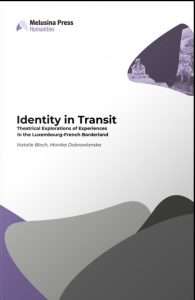
Publication of Identity in Transit: Theatrical Explorations of Experiences in the Luxembourg-French Borderland by Natalie Bloch and Monika Dobrowlanska, published by Melusina Press, Luxembourg.
https://www.melusinapress.lu/projects/1981-5760
We would like to draw your attention to the publication of Identity in Transit: Theatrical Explorations of Experiences in the Luxembourg-French Borderland by Natalie Bloch and Monika Dobrowlanska, published by Melusina Press in Luxembourg. This book is a prime example of artistic research, offering a methodology for exploring the identities of people living in border regions.
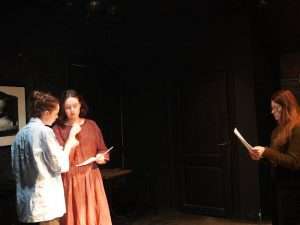
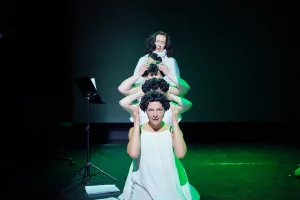
This volume focuses on the interdisciplinary theatre piece created as one component of the broader Remix Place project, part of Esch2022 – European Capital of Culture at the University of Luxembourg. This volume focuses on the interdisciplinary theatre piece created as one component of the broader Remix Place project, part of Esch2022 – European Capital of Culture at the University of Luxembourg. Based on over 65 interviews conducted in the Luxembourg-France border region the project explores people’s relationships with the places in which they live and work. Combining geography, theatre studies and photography, the project culminated in the trilingual documentary play So mir: à quels lieux tu appartiens? Eine theatralische Spurensuche im Land der Roten Erde, directed by Monika Dobrowlanska. Offering valuable insights that can inform other theatre projects, this volume is an essential read for anyone interested in the intersection of art and identity.
This publication features the complete trilingual script, photographs by David Schalliol, a video recording and two critical reflections: a conversation with the director about staging real voices, and a theatre studies essay about the participatory role of space. Offering artistic insight and academic depth, this multimedia book serves as both documentation and inspiration for future interdisciplinary and cross-border collaborations.
To provide an insight into the exciting discussions that took place as part of this project, we are pleased to present an excerpt from the conversations with the theatre makers:
“Who influences whom and why?” Monika Dobrowlanska talks about her theatre work to Natalie Bloch
NB: As a German-Polish director, you yourself have an intercultural, multilingual background. Does that give you a specific view of border regions?
MD: Maybe that’s why I carry several borders and their transgressions with me: linguistic and mental ones, but also a different historical knowledge and collective consciousness that reflects both the Polish and the German perspective. This personal imprint possibly sensitises me to the border regions in a literal and metaphorical sense. (…) In addition, of course, there is my own migration experience.
I fled Poland at the end of the 80s as a very young person because I was madly interested in the world and we in the Eastern Bloc were as good as cut off from the rest of the world. There was no freedom to travel, the “iron curtain” ran through all areas of life. This was one of the most radical border crossings in my life, between two systems and two differently shaped worlds and, consequently, ways of thinking, two opposing ideologies. At the time, we had no idea that the Soviet empire, which was believed to be eternal, already had very deep cracks and would soon fall apart.
Another very formative experience was when I was in my early 20s, still studying at the Ruhr University in Bochum, when I was engaged in an internship for theatre directing and working in various areas of the multicultural Theater an der Ruhr in Mülheim under the direction of the Italian-born Roberto Ciulli. To this day, this theatre is one of the pioneers of diversity in the German-speaking theatre landscape and one of the few exceptions that employs first-generation migrant actors who are not native German speakers.
My cosmopolitan attitude and my great interest in different cultures and their exploration in theatre have remained unchanged to this day. I have sometimes strayed into countries that are of little interest to anyone in the cultural world. They were not cool enough… (…)
I have always swum a little against the official tide of fashions and of cultural politics and simply acted – often career-damagingly – out of inner conviction, enthusiasm, solidarity with system-critical artists from politically marginalised countries, often out of curiosity for new countries, cultures, traditions. Besides, I’m a freedom-loving person and don’t like to be told what I should be interested in and artistically involved in. Artists are supposed to preserve the inner child. I think that has definitely worked for me to this day. A rift full of prejudices and misunderstandings is currently developing between Eastern and Western Europe, and there is hardly any cultural policy to counteract it. It is often forgotten that Eastern Europe is not only Russia…
NB: What interests you about border regions in general?
MD: How identities are formed and what triggers people to decide consciously or unconsciously to take one direction or another? Who influences whom and why? Also, how it is influenced by chance? How do transnational identities emerge and what does that mean in greater detail? I think that border regions have a specific liveliness and dynamism. I find these aspects, components very exciting.